

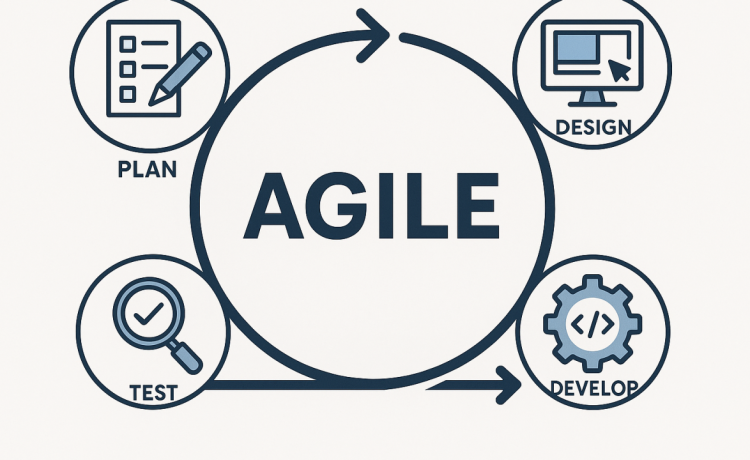
The modern operational landscape demands unprecedented adaptability from businesses of all sizes. Legacy management models, which heavily relied on fixed long-term projections and unyielding sequential phases, increasingly struggle to stay relevant in a fast-changing market. As technological disruption accelerates and customer preferences evolve unpredictably, enterprises require a structural framework designed to navigate ambiguity safely. This operational flexibility is precisely what agile management principles deliver.
Originally formalized by software developers seeking an antidote to bureaucratic project management, the agile methodology has transitioned into a universal business philosophy. It replaces top-down command structures with collaborative frameworks, continuous evaluation loops, and micro-teams capable of autonomous decision-making. By adopting these operational core values, companies can pivot their strategies dynamically, optimize internal productivity, and protect their market share against emerging competitors.
The Core Philosophy Behind Agile Systems
To implement agile effectively, leadership must first understand its foundational mindset. The strategy moves away from managing projects via fixed ironclad constraints, shifting toward managing values and outcomes iteratively. Instead of pretending that every project detail can be perfectly anticipated at the inception phase, agile presumes that change is an absolute certainty.
The overarching philosophy balances four defining core values that guide everyday operational choices:
-
Individuals and Interactions Over Processes and Tools: Prioritizing human collaboration and open workspace communication because the most advanced software tools are useless if the team is misaligned.
-
Working Solutions Over Comprehensive Documentation: Focusing energy on producing functional, real-world deliverables rather than getting bogged down in endless bureaucratic manual creation.
-
Customer Collaboration Over Contract Negotiation: Treating the end-user as an active development partner whose evolving feedback refines the final product continuously.
-
Responding to Change Over Following a Static Plan: Embracing shifting industry requirements as a competitive advantage rather than viewing adaptation as a systemic failure.
The Twelve Structural Principles of Agile Management
The broad philosophy of agile is practically executed through twelve structured principles. These rules serve as an operational compass for modern corporate development and product management.
1. Satisfying Customers Through Early and Continuous Delivery
The highest priority under an agile framework is to keep clients engaged by delivering functional value as quickly as possible. Rather than forcing a client to wait months for a massive, single-date project launch, agile provides working increments at predictable intervals. This consistent output lowers client anxiety and proves the business is actively making headway.
2. Welcoming Shifting Requirements Even Late in Development
Traditional frameworks treat change requests during late development stages as catastrophic timeline disruptions. Agile processes capitalize on change for the customer competitive advantage. If a market competitor introduces an innovative feature mid-cycle, an agile team adjusts its immediate backlog priorities to match, ensuring the final asset launches with high market relevance.
3. Delivering Working Software and Solutions Frequently
Teams are encouraged to deliver functional product increments frequently, ranging from a couple of weeks to a couple of months. Shorter operational cadences are universally preferred. This fast release strategy ensures that errors are caught early, reducing the total volume of wasted capital before a mistake compounds across broader systems.
4. Breaking Down Interdepartmental Silos Globally
Business analysts, engineers, marketers, and stakeholders must collaborate daily throughout the lifecycle of an initiative. When separate departments operate as isolated silos, communication drops, leading to handoff bottlenecks and deep misunderstandings regarding product specifications. Daily cross-functional alignment eradicates this operational friction.
5. Building Initiatives Around Motivated Individuals
Projects succeed when corporations give motivated individuals the precise environment and structural support they require, combined with absolute trust to complete the job. Micromanagement is toxic to agile velocity. Executives must shift from directing tasks to clearing institutional roadblocks, allowing specialists to execute autonomously.
6. Prioritizing Face-to-Face Interaction and Open Dialogue
The most efficient and effective method of conveying information within a development team is direct conversation. Whether co-located in a physical room or utilizing high-fidelity video tools within distributed hybrid environments, live discussions resolve complex architectural problems far faster than long, multi-recipient email threads.
7. Measuring Progress Primarily Through Functional Deliverables
In an agile ecosystem, secondary project management metrics like hours logged, tasks updated, or pages written are secondary data. The ultimate benchmark of operational progress is a fully functional product increment that performs exactly as needed in real-world environments. If software does not run or a service cannot deploy, progress is mathematically zero.
8. Promoting Sustainable Technical and Creative Development
Agile processes advocate for sustainable development speeds. All sponsors, developers, and users should be capable of maintaining a constant, predictable pace indefinitely. Avoiding crunch culture and extreme overtime blocks cognitive fatigue, preserves long-term employee retention, and keeps code and build quality uniformly high.
9. Demanding Continuous Attention to Technical Excellence
Continuous attention to superior technical design and clean structural architecture enhances overall agility. Skimping on quality to hit short-term delivery gates creates technical debt—the costly future rework required to fix rushed code. Building robust components from day one guarantees that scaling up later remains straightforward.
10. Prioritizing Radical Simplicity in Workstreams
Simplicity, defined explicitly as the art of maximizing the total amount of work not done, is absolutely essential. Teams should actively hunt for and eliminate over-engineered features, redundant approval structures, and unnecessary documentation. Eliminating non-essential fluff preserves vital engineering bandwidth for core user needs.
11. Empowering Self-Organizing Team Structures
The best architectural designs, requirement discoveries, and product innovations emerge from self-organizing teams. When a squad is given the freedom to determine how to solve a problem collectively, they exhibit a deeper psychological ownership of the outcome, resulting in superior craftsmanship compared to top-down tactical mandates.
12. Conducting Regular Operational Introspection
At regular intervals, the team reflects on how to become more effective, then tunes and adjusts its behavioral patterns accordingly. These iterative review milestones prevent systemic bad habits from hardening into organizational norms, driving a continuous culture of operational refinement.
Tactical Execution Frameworks: Transforming Principles into Action
The twelve guidelines are translated into day-to-day corporate habits through specific tactical frameworks, with Scrum and Kanban serving as the most widely adopted operational models.
The Scrum Cadence
Scrum organizes workflows into time-boxed intervals called sprints, which typically run from one to four weeks. Each sprint is a self-contained production cycle featuring specific collaborative check-ins:
-
Sprint Planning: The cross-functional team selects a realistic portion of high-priority requirements from the product backlog to tackle over the upcoming cycle.
-
Daily Stand-up Meetings: A brief fifteen-minute morning alignment session where members outline what they accomplished yesterday, what they plan to do today, and any immediate roadblocks stalling their progress.
-
Sprint Review: A demonstration at the end of the sprint cycle where the team showcases the working increment directly to corporate stakeholders to capture immediate feedback.
-
Sprint Retrospective: An internal team inspection focusing exclusively on process mechanics, where members identify internal workflow friction and commit to optimization fixes for the next sprint.
Frequently Asked Questions
What exactly is the difference between a Product Owner and a Scrum Master in agile frameworks?
The Product Owner represents the voice of the business and the consumer. They are fully responsible for defining the product vision, managing the backlog of requirements, and prioritizing which features deliver the highest financial value. The Scrum Master, conversely, acts as a servant-leader focused entirely on process optimization. They do not manage what is being built; instead, they coach the team on agile mechanics, facilitate meetings, and actively remove systemic roadblocks that slow down production velocity.
How do agile principles handle long-term corporate budgeting if product scopes change?
Agile updates the traditional fixed-scope annual budgeting model into an incremental funding structure. Instead of allocating a massive multi-million dollar budget to a static project definition two years in advance, leadership funds persistent product streams or value hubs. Capital is released incrementally based on the team’s ongoing ability to demonstrate working, high-value solutions at the end of each sprint cycle, allowing corporations to halt underperforming initiatives quickly.
Can a team mix agile techniques with traditional waterfall project management?
Yes, this hybrid methodology is commonly referred to as hybrid-agile or structured agile. It is frequently deployed by large organizations dealing with complex regulatory constraints or mixed hardware-software integrations. In a hybrid setup, the overarching corporate macro-strategy, procurement cycles, and regulatory deadlines are managed via linear milestones, while the actual design, software coding, and feature testing phases are executed through rapid, iterative agile sprint cycles.
How should a manager handle performance evaluations for individual employees within an agile team?
Individual performance evaluations must evolve to match the collaborative reality of agile. Traditional metrics that measure isolated personal output can inadvertently encourage internal competition and damage team dynamics. Successful agile organizations incorporate peer reviews, evaluate contribution patterns toward overall sprint velocity, and measure how effectively an individual helps their squad hit collective sprint commitments rather than just checking off siloed tasks.
What is technical debt, and how does agile explicitly prevent it?
Technical debt refers to the future operational cost and systemic friction a company incurs when it chooses short-term, sloppy fixes over elegant, robust design solutions. Agile combats technical debt through its emphasis on continuous technical excellence and explicit definitions of done. By mandating automated code testing, pair programming, and continuous integration testing inside every single sprint cycle, agile ensures that quality checks are performed constantly rather than being postponed to the end of a project lifecyle.
How do distributed or fully remote workforces maintain agile velocity without physical boards?
Distributed teams maintain high operational velocity by replacing physical workspaces with digital collaboration ecosystems. Cloud-based project management platforms provide real-time visibility into the workflow status of every task, functioning as a single source of truth. Combined with asynchronous communication norms, clear documentation hubs, and reliable video conferencing software for daily stand-ups, remote teams can self-organize and execute sprints seamlessly across multiple time zones.