

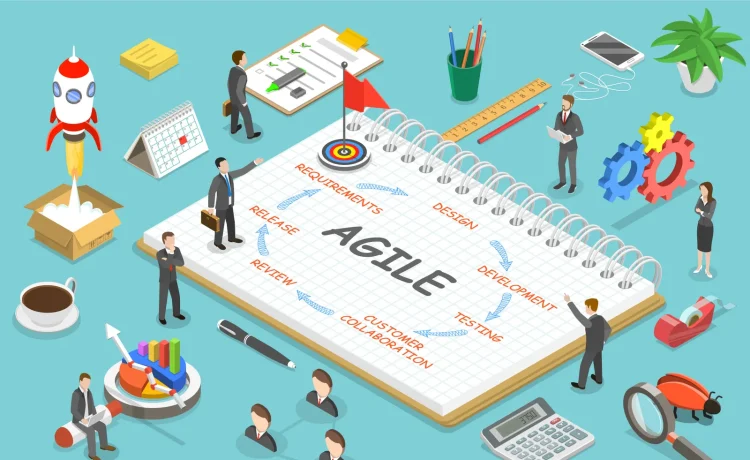
In an era of rapid technological advancement and shifting economic landscapes, market volatility has become the baseline norm for global commerce. Industries that once enjoyed decades of stability now experience profound disruptions over the span of single fiscal years. Facing these unpredictable conditions, traditional long-term forecasting models and highly rigid organizational frameworks are increasingly obsolete. To survive and achieve sustainable growth, modern enterprises are pivoting toward agile management structures as a primary vehicle for securing market competitiveness.
Originally conceived within the software engineering sector to streamline product delivery, agile methodology has evolved into a comprehensive corporate philosophy. This system replaces bureaucratic corporate hierarchies with adaptive workflows, iterative feedback loops, and cross-functional team autonomy. By structuring an organization to favor fluid responsiveness over static, multivariable upfront planning, businesses can pivot rapidly to capture emerging market opportunities and systematically mitigate operational risk.
Deconstructing the Limitations of Legacy Systems
To appreciate the competitive advantages offered by agile frameworks, it is necessary to examine the systematic vulnerabilities of traditional management paradigms, specifically the waterfall model. The waterfall method treats project management as a strictly linear sequence, moving incrementally through phases such as requirement gathering, design, implementation, verification, and maintenance.
While a linear framework functions adequately in highly predictable environments with unyielding constraints, it introduces profound risks into modern corporate environments. Under the waterfall structure, a business commits substantial capital and human resources to a fixed objective months or years before the final product debuts in the marketplace. If consumer preferences alter, a new competitor emerges, or a macroeconomic shock occurs mid-cycle, the company cannot easily adjust its course. The business remains committed to an obsolete strategy, ultimately delivering solutions that no longer align with prevailing market realities.
Furthermore, traditional corporate design isolates specialized departments within distinct silos. Engineering, marketing, quality control, and legal departments operate as isolated islands, communicating primarily through formal bureaucratic channels. This division creates substantial friction, slows communication to a crawl, and obfuscates the ultimate objective: delivering optimal value to the end consumer.
Core Operational Drivers of Agile Competitiveness
Agile management dismantles legacy vulnerabilities by re-engineering how work is categorized, executed, and evaluated. Rather than viewing a major corporate goal as a massive monolithic project, agile splits initiatives into manageable, incremental cycles known as sprints, which generally last between one and four weeks. The core competitive strengths of this iterative framework can be broken down into three fundamental pillars.
Enhanced Market Response Speed
The primary metric of success within an agile business model is velocity—the speed at which a team can successfully transition an idea from conceptual design to a functional market release. Because production cycles are compressed into rapid sprints, organizations can test real product variations in active market conditions almost immediately.
This accelerated deployment cadence creates an ongoing competitive feedback loop. If an assumption proves incorrect, the monetary loss is strictly limited to the duration of a single sprint rather than the budget of an entire fiscal year. This allows companies to refine features, pivot marketing directions, and correct mechanical errors proactively before substantial capital is permanently compromised.
Direct Integration of the Customer Voice
Traditional project management positions consumer research as a bookend activity, occurring exclusively at the inception of a project and the final release phase. Agile structures reverse this trend by treating user feedback as a continuous, active driver of product iteration.
-
Continuous Validation: Every sprint concludes with an operational demonstration or review, where active stakeholders evaluate progress against real-world user metrics.
-
Co-Creation Models: Product requirements are framed as active user stories rather than static technical declarations, maintaining a constant emphasis on user utility.
-
Minimized Waste: Consistently measuring real-user engagement metrics prevents teams from investing engineering hours into complex features that consumers do not want or use.
Autonomy via Cross-Functional Synergy
Agile abandons the traditional corporate approach of departmental isolation. Teams are assembled as small, cross-functional squads containing all the specialized skills required to complete a project autonomously, including designers, developers, market researchers, and quality assurance personnel.
By granting these squads full ownership over specific product components, businesses eradicate the long delays associated with top-down administrative approvals. The team closest to the product and the customer makes day-to-day decisions independently, yielding significant gains in production velocity and localized problem-solving efficiency.
Strategic Cultural Re-engineering and Employee Retention
While the outward mechanics of agile are often measured through software deployments and production timelines, the true competitive differentiator is cultural. Agile requires a deliberate transition from a culture of command-and-control to one of psychological safety and shared accountability.
Overcoming the Stigma of Failure
In rigid corporate environments, mistakes or missed projections are met with punitive administrative measures, which conditions employees to mask inefficiencies and avoid taking creative risks. Agile reframes failure as an essential component of empirical data collection.
During the retrospective meeting that marks the completion of each sprint, teams explicitly examine operational failures without assigning personal blame. The objective is to identify root causes and optimize internal workflows for the subsequent cycle. When employee anxiety surrounding error is minimized, innovative exploration thrives, enabling companies to pioneer breakthrough products ahead of risk-averse market competitors.
Boosting Morale and Attracting Top Talent
High-performing professional talent naturally gravitates toward corporate environments characterized by autonomy, mastery, and purpose. Agile directly fulfills these preferences by empowering teams to self-organize and determine their own capacity boundaries during sprint planning sessions. This autonomy cultivates a deep sense of psychological ownership over the final product, which correlates directly with reduced employee burnout, higher baseline retention metrics, and superior creative output.
Financial Resilience and Capital Conservation
Beyond product development, agile frameworks provide chief financial officers and executive leadership with an agile tool for capital preservation. Traditional budgeting relies on massive annual allocations, locking corporate funds into long-term initiatives that may lose economic viability long before conclusion.
Agile budgeting operates on an incremental model. Capital is allocated to product streams based on their ongoing ability to hit targeted performance indicators and demonstrate tangible value with every sprint. If a market shift devalues a project, leadership can instantly redirect the remaining capital to high-yield business units. This prevents the sunk-cost fallacy from draining corporate reserves, guaranteeing maximum return on invested capital even during wider market fluctuations.
Frequently Asked Questions
Is agile management exclusive to tech companies, or can it apply to traditional manufacturing?
Agile principles originated in tech but apply across all traditional industries, including hardware manufacturing, healthcare, and financial services. While physical manufacturing involves immutable constraints like tooling and supply chain lead times, companies apply agile by adopting iterative prototyping, cross-functional engineering teams, and modular design. This allows organizations to adjust sub-components and software integration without overhaul of the physical footprint.
How does implementing an agile framework affect overall corporate governance?
Agile shifts governance from a model of micro-management to macro-alignment. Instead of monitoring tasks, hours, and procedural checklists, executive leadership establishes high-level strategic parameters and objective key results. Governance is maintained through automated metrics dashboards, sprint reviews, and product increments, giving leadership visibility into real outcomes without choking operational velocity.
What is the difference between Scrum and Agile management methodologies?
Agile is an overarching management philosophy guided by values like collaboration, flexibility, and iterative development. Scrum is a specific, highly structured operational framework used to implement those broader agile values. Scrum defines explicit organizational roles like Scrum Master and Product Owner, and mandates specific collaborative cadences including daily stand-ups, sprint planning, and retrospective meetings.
How should a large corporation manage the initial resistance to an agile transformation?
Resistance is minimized by eschewing sudden, top-down mandates in favor of a graduated pilot strategy. Leadership should select a single, high-leverage product team to transition to agile practices first. Once this pilot team demonstrates velocity gains, cultural improvements, and reduced defect rates, the resulting internal data provides a compelling case that naturally drives adoption across other corporate business units.
Can agile management work effectively with entirely remote or hybrid workforces?
Agile is well-suited for distributed teams because it prioritizes explicit transparency and asynchronous documentation. By leveraging digital kanban boards, centralized video communication platforms, and collaborative sprint management software, remote workers maintain alignment on priorities. The emphasis on outcomes over physical presence allows hybrid teams to preserve operational velocity without co-location.
How does agile manage complex projects with firm, unyielding regulatory deadlines?
Agile addresses strict external deadlines by fixing the delivery timeframe while making the product scope variable. Instead of trying to build every feature simultaneously for a single launch date, the team prioritizes regulatory compliance elements during early sprints. This ensures a fully compliant core product is functional well before the hard deadline, while non-essential feature sets are scheduled for post-compliance updates.